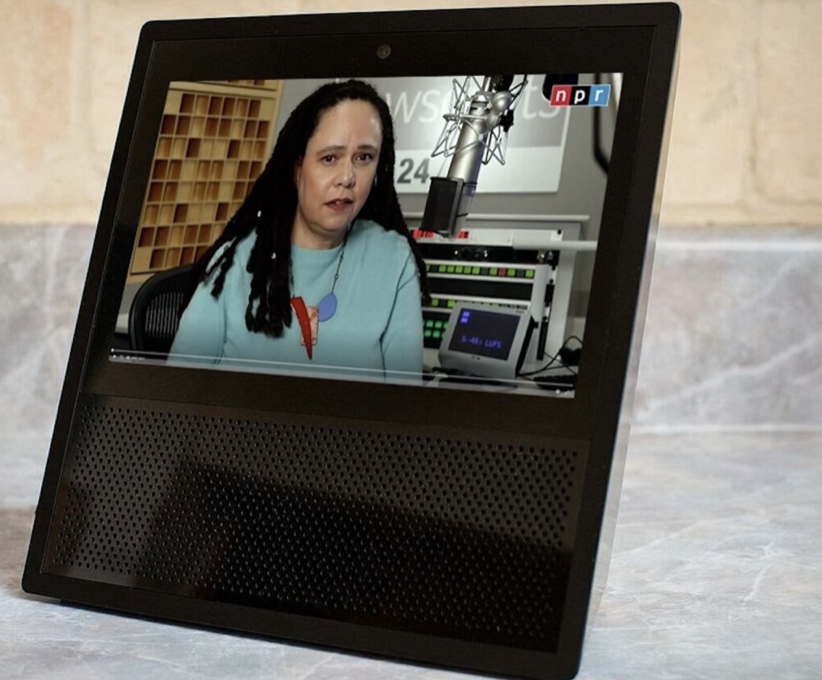
NPR illustration.
I am going to use this period between Christmas and the New Year to use the word “I” in a Laurel post so that I may reflect on the place the hourly newscast holds in the world of journalism. This post of memories and other thoughts is inspired by an episode of the Consider This podcast from National Public Radio(NPR).
In the late 1980s and into the mid ’90s, most AM and many FM radio stations in Connecticut had full news staffs of five people or more. In certain parts of the state, like southeastern Connecticut, where I worked for four years(WICH/WCTY), it was not unusual for four different local radio stations to show up to cover regional news events. The competition among reporters to be the first to run to a pay phone and report live at the top of the hour(often purposely denying access to the phone to the competition) was intense.
During that period of media history, the hourly radio newscast was the gold standard in terms of immediacy. Most stations carried either a local newscast, or a network newscast, on the hour. It was taken seriously. Reporters working for newspapers and television stations made sure they were listening for up to the minute updates.
Working for WPOP in Hartford, during its final years as a locally produced all-news station, we carried ABC News at the top of the hour(after losing our CBS affiliation to WTIC). Five minutes before the top of the hour a producer would key the mic, and with the sound of a busy New York newsroom in the background, preview the upcoming top story. “Pending further developments,” he would say, “our top story this hour is….”
The phrase “pending further developments” was meant to imply that ABC News had its eyes on the entire world and if anything changed in the next five minutes, anything at all, they would change the top story. They were prepared to make that difficult decision, if it became necessary.
At CBS stations, the most prestigious top of the hour newscast was the World News Round-up; a ten minute newscast that still airs today at 8a.m. ET. It first went on the air in 1938 to cover developments in Europe in the years before U.S. involvement in World War II. Over the years, it was anchored by the biggest names at CBS News and was one of the broadcasts that gave CBS its reputation as the Tiffany Network.
My favorite top of the hour newscast memory however comes from my time as a part-time anchor at WTIC-AM during the mid-1980s. While working full time during the week in the southeastern part of the state, I would drive up to Hartford at nights and on the weekends to anchor top and bottom of the hour newscasts.
Under the leadership of Walt Dibble, WTIC-AM newscasts were all inclusive. We were encouraged to “lead local,” but we were also encouraged to put things in perspective for listeners from Maine to the Connecticut shore. If we thought a national or international story was more important, the local news could wait. Walt told me the job was to “brief the audience on everything that had happened in the last 24 hours.”
Each newscast was crafted. Careful attention was paid to the order of the stories, the transitions from one story to the next, and the writing. Did the writing of each story demand the attention of the audience?
Sportscaster Arnold Dean told me that in print, you can take all day getting to the point of the story in the first paragraph or two. On the radio you had to get right to it. “The Pope’s been shot!” Followed by the sound of a gut punch, was Dean’s way of explaining it to me.
One of my favorite shifts was Sunday morning – 5a.m.-1p.m. All morning long I had the newsroom to myself as I crafted about a dozen separate and unique scripts for top and bottom of the hour newscasts that I imagined were being heard across New England – from north to south. Farmers working their fields and listening on transistors, families driving to church, or sitting around the kitchen table for Sunday breakfast. They got the full briefing; from Uncasville to Sri Lanka, from Paris to Bantam.
Around 12:30p.m., the afternoon anchor would come in(often Peggy Ford) and I would brief her on the state of the world to give her a running start. Nothing ever beat the feeling for me of walking out of the front door of the Gold Building in downtown Hartford – at around 1:30 in the afternoon – with the sense that I had just spent the morning providing essential information to thousands of people throughout the northeast. The thing I loved most was being anonymous. No one knew who I was as I walked to my car, but I knew the importance of how I had spent my morning.
According to the Consider This podcast(I linked at the top of this post) the NPR top of the hour news is the most listened to podcast in the nation in some rankings. Whether they know it or not, news sites like Axios, Politico, and the almost endless number of newsletters that are published online today, can trace their approach to coverage and writing to the top of the hour radio newscast. The goal and the writing styles are similar, if not the same.
At WTIC, we finished our newscasts by repeating the top story of the hour. Another nod to the idea that things were changing rapidly, and you would definitely want to tune in at the top of the next hour to hear the latest. So…
The WTIC top story this hour: The format of the top of the hour newscast is relevant today and remains an efficient way to deliver and consume the news, whether on an old fashioned radio, or on your cell phone.
Next news in thirty minutes. Bulletins at once.
I’m Dean Pagani. WTIC Ten-Eighty News.


